
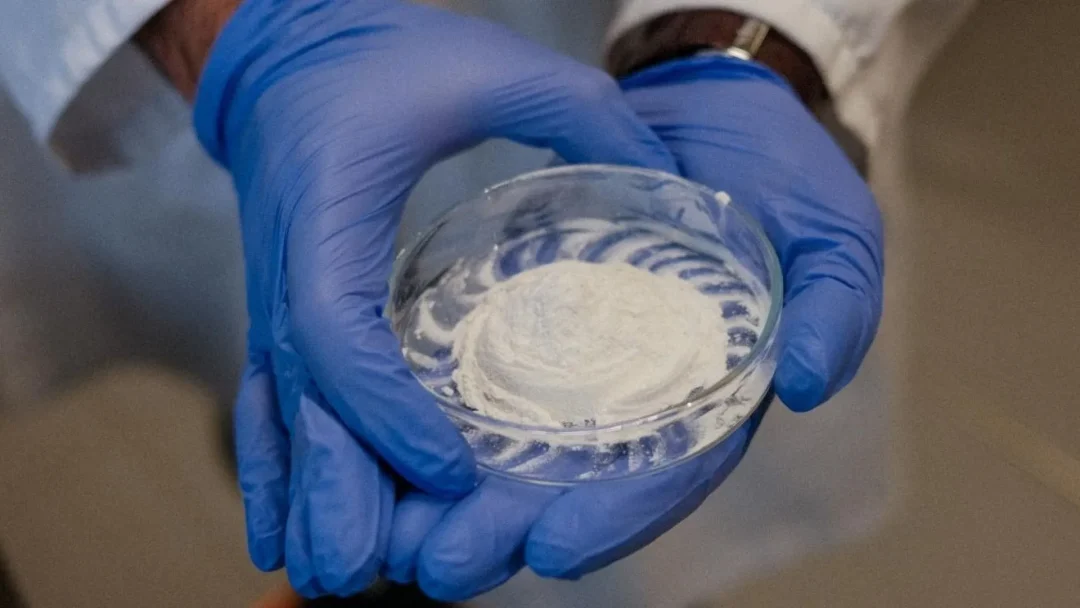
What if the tiny plastic particles in your face wash, your foundation, and your shampoo could be replaced with something that simply disappears – not into a landfill, not into the ocean, and definitely not into our food chain, but back into the natural world? What if something that currently accumulates in our blood, our lungs, and our food chain could be swapped for one made from trees, that biodegrades completely once it has done its job? What if all of this was possible without reformulating the product or sacrificing the texture customers love? This is what Naturbeads have built.
Naturbeads is a Bath-based materials company, spun out of the University of Bath in 2018, that produces cellulose microspheres to replace plastic microparticles in cosmetics, life science applications, paints, and industrial products. They are a prime example of a symbiotic business: one that delivers not just economic value, but also ecological and social.
What is Naturbeads?
Naturbeads’ core product is a cellulose microsphere, a perfectly round, biodegradable particle made from cellulose, the same natural polymer that makes up trees and is the most abundant biopolymer on Earth. Using a patented process developed at the University of Bath’s Centre for Sustainable and Circular Technologies (CSCT), the team transforms certified industrial cellulose into smooth, spherical particles without altering their chemistry. The process also operates as a continuous system that recycles all solvents used, keeping its own environmental footprint minimal.
The result is a particle that behaves, in formulation, exactly like its plastic equivalent (similar to Vivomer!). Same texture, performance, oil adsorption, porosity control, and compatibility with both hydrophilic and hydrophobic products. Particles are produced in a range of sizes from 1 to 50 micrometres, matching the specifications used in cosmetic and industrial applications – now with full certification and traceability. The only difference you’ll find is that when they enter soil or water, microorganisms can consume them completely. That means we don’t have the environmentally damaging microplastics, and their accumulation in our bodies.
“At Naturbeads, we prevent microplastic pollution by replacing microplastics particles with natural, biodegradable ingredients. Tackling the problem at the source while maintaining the same performance and cost as plastics through innovative particle technology.” – Naturbeads
What makes Naturbeads symbiotic?
A symbiotic business, as described in Frank Birkin’s Symbiotic Businesses, is a business that has ecological and social benefits, as well as economic ones.
Ecologically, microplastic pollution is one of the most persistent environmental problems of the industrial age. Emissions of microplastics to the environment are estimated at between 10 and 40 million tonnes per year globally, and under current trends that figure could double by 2040. The European Chemicals Agency (ECHA) estimates that around 145,000 tonnes of microplastics are used intentionally in products in the EU and European Economic Area each year – including as exfoliating agents, texture modifiers, and stabilisers in cosmetics and personal care products. Once washed down the drain, they pass through wastewater systems that cannot filter particles at that scale, and accumulate in rivers, soils, and oceans – where they won’t degrade. Naturbeads’ cellulose microspheres tackle this at the source, replacing the plastic particle before it ever enters the supply chain, and before it can begin to accumulate.
Socially, microplastics are no longer just an environmental concern, they’re a human health concern. They have been detected throughout the human body, including in blood, lungs, liver, placenta, and breast milk. Studies have linked microplastic exposure to oxidative stress, immune disruption, and emerging associations with cardiovascular risk. However, even these studies struggle – with exposure being “ubiquitous in the environment” finding a control group is practically impossible. With people estimated to inhale around 68,000 microplastic particles every day, the cosmetics sector, where microparticles are rinsed directly off skin and into water systems, is one of the most direct routes of exposure.
Economically, Naturbeads is well-positioned as regulations and markets shift. The EU’s REACH restriction on intentionally added microplastics (2023/2055) requires a phase-out of plastic microparticles in cosmetics and other products, with a 12-year transition period for many product categories. That transition is driving demand for credible alternatives. With Naturbeads having received £7.8 million of funding in Series A 2024, and secured €4.1 million in EU structural funding for a production plant in southern Italy, and opened their first commercial-scale manufacturing facility in 2025, Naturbeads is scaling well into this window of regulatory opportunity.
Naturbeads in the cosmetics sector
The cosmetics and personal care sectors sit at a difficult intersection. They rely on microparticles to deliver the textures, finishes, and functional performance that consumers expect. The regulatory and reputational pressure to move away from those plastics places pressure to become more eco-friendly, but the challenge is that alternatives must perform to the same specification. Customers, while generally supportive of sustainability and eco-friendliness, don’t want products with a compromised finish or feel.
This is where Naturbeads comes in. They’ve optimised with a performance-first approach while integrating sustainability. Their particles achieve the same sphericity, range of particle sizes, and surface properties, without needing petrochemicals. For cosmetics formulators, they integrate into existing product development pipelines with full technical dossiers, certified and traceable cellulose sourcing, and compatibility across both rinse-off and leave-on formats.
Naturbeads are also developing applications in life science (biocompatible particle carriers), paints and coatings, and industrial sectors, making their biodegradable microsphere technology a platform they can grow and scale from.
Naturbeads is just one of the examples of symbiotic businesses you can find on the Intrinsic Spring database. If you’d like to read about another company in the plastic alternatives space, why not read about Vivomer by Shellworks, who have developed a bio-based plastic alternative that completely biodegrades in soil, water, and home compost. Or, if sustainable materials in the construction sector interest you, check out Made of Air, a company manufacturing carbon-negative materials to replace MDF boards and thermoplastics. And if you’d like to explore another University spin-out tackling a systemic environmental problem, take a look at UK Hempcrete, who use UK-grown hemp to produce carbon-negative building materials.
