
Businesses today face increasing pressure to demonstrate their environmental, social and economic value. Frameworks such as ESG, GRI and B Corp have emerged to help organisations measure impacts, manage risks and improve accountability. While these approaches have made important contributions, they can also be complex, expensive and time-consuming, particularly for smaller organisations.
The Symbiotic Business Assessment™ offers a different approach. Rather than focusing primarily on compliance, reporting or certification, it evaluates how effectively a business creates mutually beneficial relationships among people, communities, economies and nature. By placing relationship quality, shared prosperity and regeneration at the centre of assessment, it provides a simple and accessible framework for understanding business contribution in a rapidly changing world.
This article explores why a symbiotic approach may represent the next evolution of business assessment and how it aligns with the broader vision of a flourishing and regenerative economy.
Over the past two decades, sustainability frameworks such as ESG, GRI and B Corp have helped businesses become more accountable, transparent and responsible. These approaches have made important contributions by encouraging organisations to measure impacts, manage risks and report on their environmental and social performance.
However, they largely focus on what businesses do, what they report, or how they comply with recognised standards.
The Symbiotic Business Assessment™ begins with a different question:
How effectively does a business create mutually beneficial relationships that enable people, communities, economies and ecosystems to flourish together?
This distinction is important.
From Reporting to Relationships
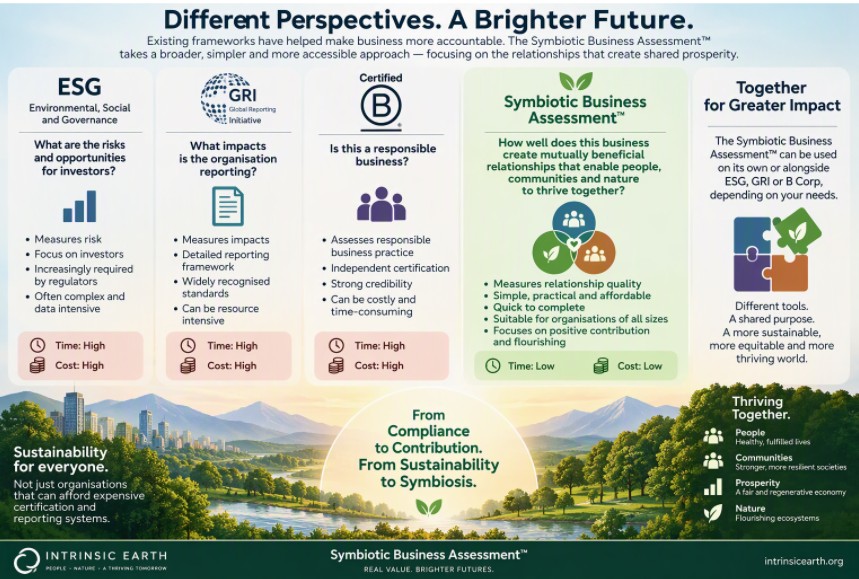
The Global Reporting Initiative (GRI) helps organisations report their impacts. B Corp assesses responsible business practices. ESG frameworks help investors evaluate risks and opportunities.
The Symbiotic Business Assessment™ evaluates the quality of relationships.
Rather than examining environmental, social and governance issues as separate categories, it asks whether a business contributes to a healthy and balanced system in which all stakeholders benefit.
For example:
- Do employees thrive alongside the business?
- Do local communities benefit from business success?
- Does the natural environment become healthier rather than merely less damaged?
- Does the business create long-term shared prosperity?
- Are value exchanges fair, balanced and regenerative?
Beyond Harm Reduction
Many sustainability initiatives focus on reducing negative impacts:
- Lower emissions
- Less waste
- Reduced risk
- Improved compliance
These objectives remain essential.
However, the Symbiotic Business Assessment™ also measures positive contribution.
It asks:
- What value is being created?
- What capabilities are being developed?
- What relationships are being strengthened?
- What regeneration is occurring?
In other words, the focus shifts from doing less harm to creating more good.
Nature as a Partner
Traditional business assessments often treat nature as a resource, an externality or an environmental reporting category.
The Symbiotic approach views nature differently.
Nature is not simply something to be protected. It is a foundational partner in human and economic flourishing.
A truly symbiotic business seeks to prosper while simultaneously contributing to resilient ecosystems, recognising that long-term economic health ultimately depends upon ecological health.
A Whole-System Perspective
Perhaps the greatest strength of the Symbiotic approach is that it can be applied consistently across multiple domains.
The same principles can be used to assess:
- Individuals
- Families
- Businesses
- Communities
- Cities
- Economic sectors
- Artificial intelligence systems
This creates a coherent framework linking:
- Symbiotic Living
- Symbiotic Business
- Symbiotic Communities
- Symbiotic Technologies
- Symbiotic Economies
All are evaluated through the same lens of relationship quality, reciprocity, balance and mutual benefit.
A Simpler and More Human Framework
While many sustainability frameworks have become increasingly complex, technical and compliance-oriented, the Symbiotic model is built around concepts that people instinctively understand:
- Balance
- Reciprocity
- Contribution
- Regeneration
- Flourishing
- Mutual benefit
These principles resonate across cultures, sectors and levels of society.
The Future of Sustainable Development
ESG, GRI and B Corp will continue to play important roles. The Symbiotic Business Assessment™ is not intended to replace them. Instead, it offers a broader perspective that integrates and extends their strengths.
Where ESG measures risk, GRI measures impacts and B Corp measures responsible practice, the Symbiotic Business Assessment™ measures the health of the relationships that underpin long-term prosperity.
Ultimately, the question is not simply whether a business is sustainable.
The deeper question is:
Does this business contribute to a world in which people, organisations, communities and nature can thrive together?
That is the central purpose of the Symbiotic Business Assessment™ and the foundation of a truly symbiotic economy.
Key Insight
Most sustainability frameworks measure impacts, disclosures and risks. The Symbiotic Business Assessment™ measures the quality of the relationships that create shared prosperity for people, communities, economies and nature.
