
Why relationships come first
For 30 years I’ve argued one thing: business runs on the wrong picture of reality.
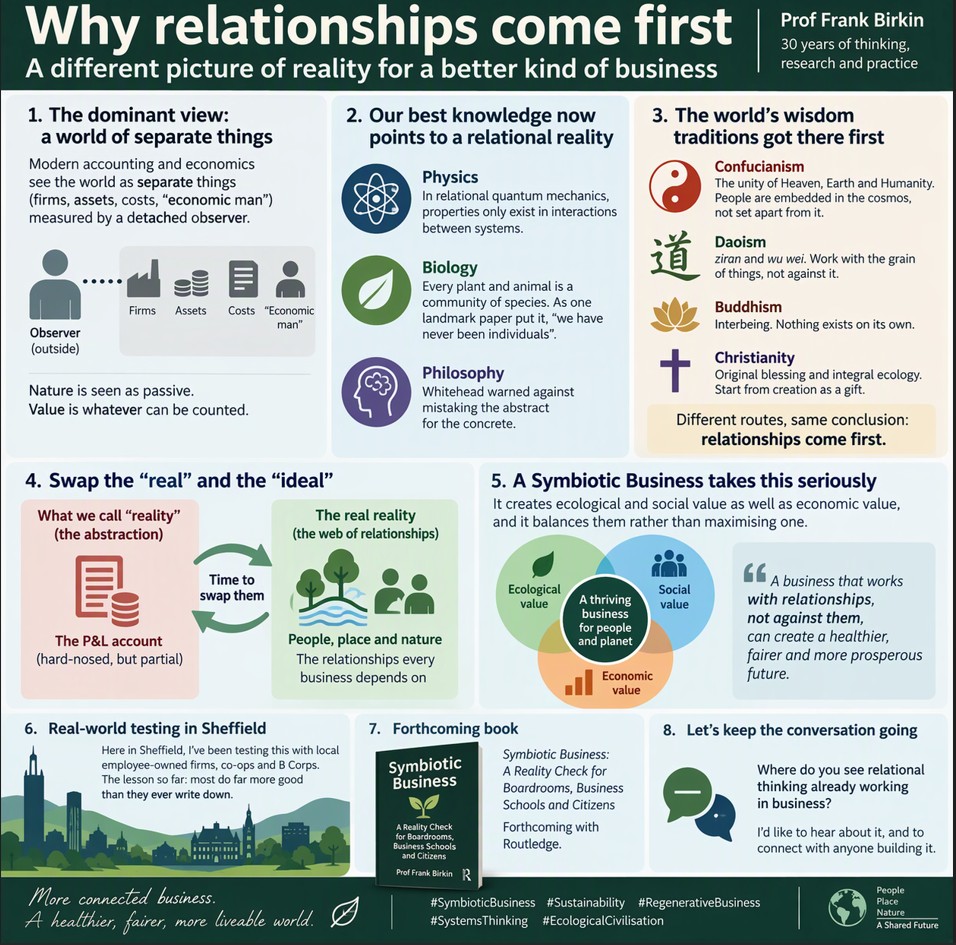
It started with a 1996 paper, “The Ecological Accountant: from the Cogito to Thinking Like a Mountain”. Modern accounting and economics see the world as separate things (firms, assets, costs, “economic man”) measured by a detached observer. Nature is passive. Value is whatever can be counted.
Look at where our best knowledge now points:
→ Physics: in relational quantum mechanics, properties only exist in interactions between systems.
→ Biology: every plant and animal is a community of species. As one landmark paper put it, “we have never been individuals”.
→ Philosophy: Whitehead warned against mistaking the abstract for the concrete.
The world’s great wisdom traditions got there first:
→ Confucianism: the unity of Heaven, Earth and Humanity. People are embedded in the cosmos, not set apart from it.
→ Daoism: ziran and wu wei. Work with the grain of things, not against it.
→ Buddhism: interbeing. Nothing exists on its own.
→ Christianity: original blessing and integral ecology. Start from creation as a gift.
Different routes, same conclusion: relationships come first.
So I propose swapping the “real” and the “ideal”. The P&L account we call hard-nosed reality is the abstraction. The web of relationships every business depends on (people, place, nature) is the reality.
A Symbiotic Business takes that seriously. It creates ecological and social value as well as economic value, and it balances them rather than maximising one.
Here in Sheffield, I’ve been testing this with local employee-owned firms, co-ops and B Corps. The lesson so far: most do far more good than they ever write down.
My book Symbiotic Business: A Reality Check for Boardrooms, Business Schools and Citizens is forthcoming with Routledge.
Where do you see relational thinking already working in business? I’d like to hear about it, and to connect with anyone building it.
Professor Frank Birkin, 27/11/2026
#SymbioticBusiness #Sustainability #RegenerativeBusiness #SystemsThinking #EcologicalCivilisation
