Love Yourself & the Planet: Food, Health, Romance & Action
Love Cultivated Meat – Better Health for you & planet

Love Cultivated Meat – Better Health for you & planet

So much news is rightly dominated by external environmental crises: climate change, wildfires, heatwaves, extinctions, pollution, waste mountains, habitat loss and plastics. But this does not mean we should overlook the related crises internal to ourselves: for example, the allergy crisis. The Allergy Crisis in Figures “Allergy is the most common chronic disease in Europe. Up to 20% of patients with allergies struggle daily with the fear of a possible asthma attack, anaphylactic shock, or even death from an allergic reaction.” “More than 150 million Europeans suffer from chronic allergic diseases and the current prediction is that by 2025 half of the entire EU population will be affected.” “Seven times as many people were admitted to hospital with severe allergic reactions in Europe in 2015

The biggest question of the age is “How did we forget our deep relations with nature?” Climate change, pollution, resource depletion, species loss and even human isolation, depression, lack of identity and dissatisfaction can be explained by our loss of natural relations. In this blog, we can explore an explanation of how we began to lose our sense of natural heritage and contrast it with a belief system for which nature is very much alive and meaningful. We can put together one answer to that question by contrasting aspects of European and Chinese religions. Ancient China had enjoyed a very different relationship with nature from that to be found in Christian Europe. Respective attitudes towards dragons may help to make the distinction clear. In Europe,

Have you tried plant-based meat and dairy? Not as good as the real thing is it? But that will change. Anyone concerned about the terrible, unsustainable impacts of livestock production, will welcome major changes to farming industries. Rearing animals so that we can eat them emits 18% of all anthropogenic greenhouse gases and is a major cause of water shortages and deforestation. However, even if no-meat products are brilliant for sustainability, nutrition and affordability, they will not sell if taste, smell or texture is not up to the mark. So, a next generation of cultivated meat is now undergoing approval around the world. The Dutch company Meatable is a pioneer in cultivated meat products. Their products have the potential to recreate the tastes, smell, texture,

Plastics – Nature’s Guardian, Our Benefactor ….. & Polluting Biohazard! John Wesley Hyatt won $10,000 to find a substitute for the ivory that was once in high demand to make billiard balls for the popular sport. The demand for ivory as well as other natural products such as tortoiseshell, horn and linen was depleting natural resources. People wanted alternatives to help save nature. This happened in 1869 and Hyatt had discovered how to make plastics. His invention provided a revolutionary, nature-saving solution. Hyatt’s plastic could be crafted into a variety of shapes and made to imitate many natural substances. Industry could now create many new materials to reduce the depletion of the natural world. Advertisements of the day praised Hyatt’s plastic as the saviour of

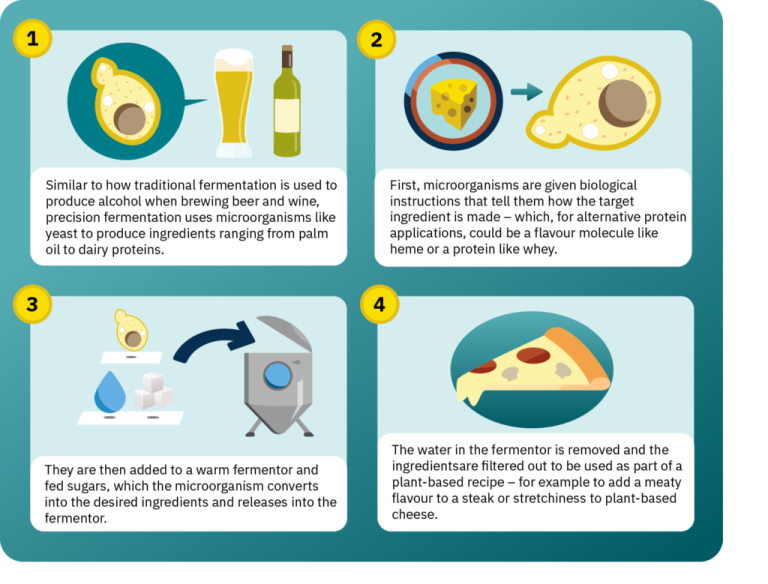
The First Domestication was about Macrobiology – life that we can see. The Second Domestication is about life that we cannot see so readily – the microorganisms – and Precision Fermentation.

Business Redesign One of the biggest questions for all of us right now is how to make business sustainable. Unless we are to return to living in relatively isolated hunter gather communities, then we will need to collaborate to clothe, house, feed and entertain ourselves. That will be, in the broadest of terms, doing the business. So how will we do it? Who will own, co-ordinate, direct and manage truly sustainable businesses? What will a sustainable business model look like – would we recognise it? Paul Hawken, the American entrepreneurial ecological activist, considered these questions and decided that it is: Hawken, P. (1993). The Ecology of Commerce. London: HarperCollins. pp. XIII-IV I agree with Paul. We need to drink deep in the Intrinsic Spring, be

Recognising the Transformation In recent decades, many changes have been made in business and society to deal with sustainability and the impacts of new technologies. But these changes mark only the end of the beginning of a major transformation. The current ‘take, make, waste’ economy is increasingly being criticised by society, industry and politics because it is facing raw material, ecological and social limits. It is time for local authorities, agencies, businesses, educational institutions, NGOs, you and me – the citizens, to seize the initiative and lead the way to Better Lives for All. Evidence of the transformation is widespread and has been accumulating for decades. For example, some notable milestones include the numerous Climate Change Agreements such as: the Kyoto Protocol, adopted in 1997

The Intrinsic Spring In preparation for this first blog post, I asked a few friends just what Intrinsic Spring meant in their lives. They told me – so let’s get their funnies out of the way before we get down. Intrinsic Spring is not a car part, an upholstery support, a bar, a plumbing emergency, a prosthetic limb, a jack-in-the-box, a watch drive, a revised Fosbury Flop, a sprightly walk, a joke cushion, an indoor fountain, an outdoor foundation, a pacemaker or a new kind of Pogo Stick. Thanks for that! Joking aside, Intrinsic Spring refers to the stuff of everyday slipping bye, renewing, transforming, resetting the scene as the bees busy in the geraniums that I watch whilst I write; the granite crystals in
Help Make Good Change Happen
With
New Knowledge
New Values
New Opportunities
Join our Social Movement & help create vibrant living communities that support the kind of businesses, governments and people that we so urgently need for sustainability, to give ourselves a future.