
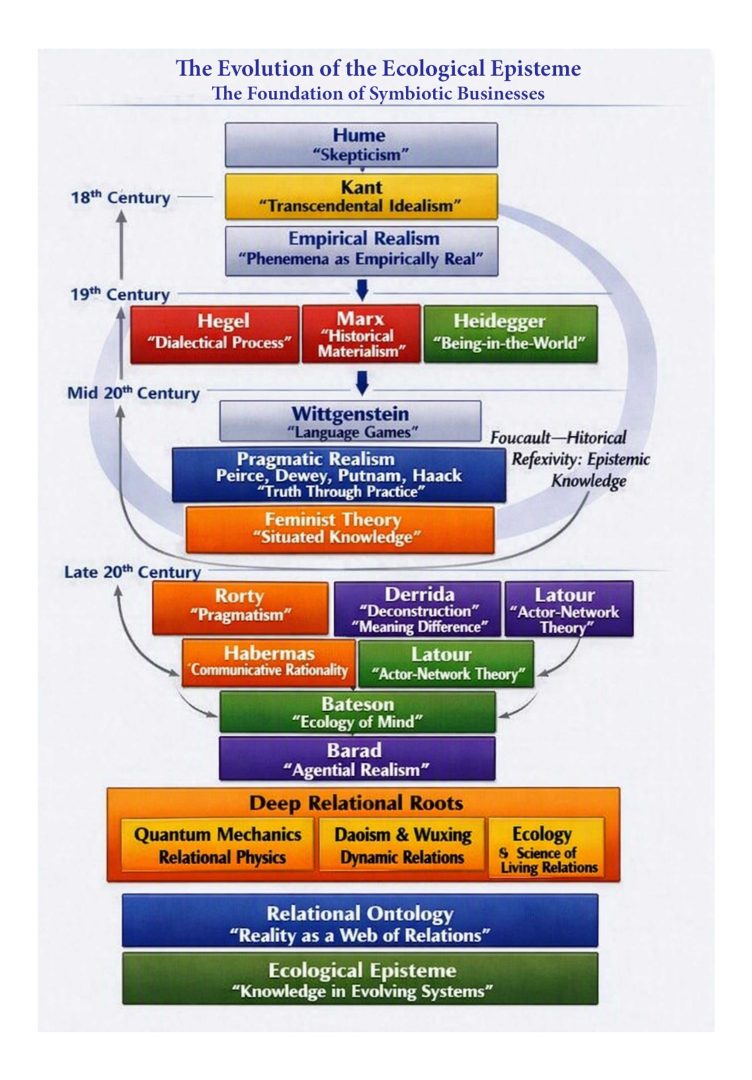
.For decades, business thinking has been shaped by mechanistic assumptions that regard organisations as machines, people as units, and value as economic output. But beneath that surface, a different intellectual lineage has been quietly evolving.
The Evolution of Relational Ontology traces this shift: from structural and systems thinking, through ecological science and relational agency, toward a worldview where connection, interdependence, and capability define how systems actually work.
This relational lineage is the foundation of Symbiotic Business. It shows that symbiosis isn’t a new idea: it’s the next practical application in a long philosophical evolution. By understanding this progression, we can see why organisations must move beyond control and efficiency, and begin designing for relationships, resilience, and living‑system dynamics.
This chart is the map. Symbiotic Business is a consequence
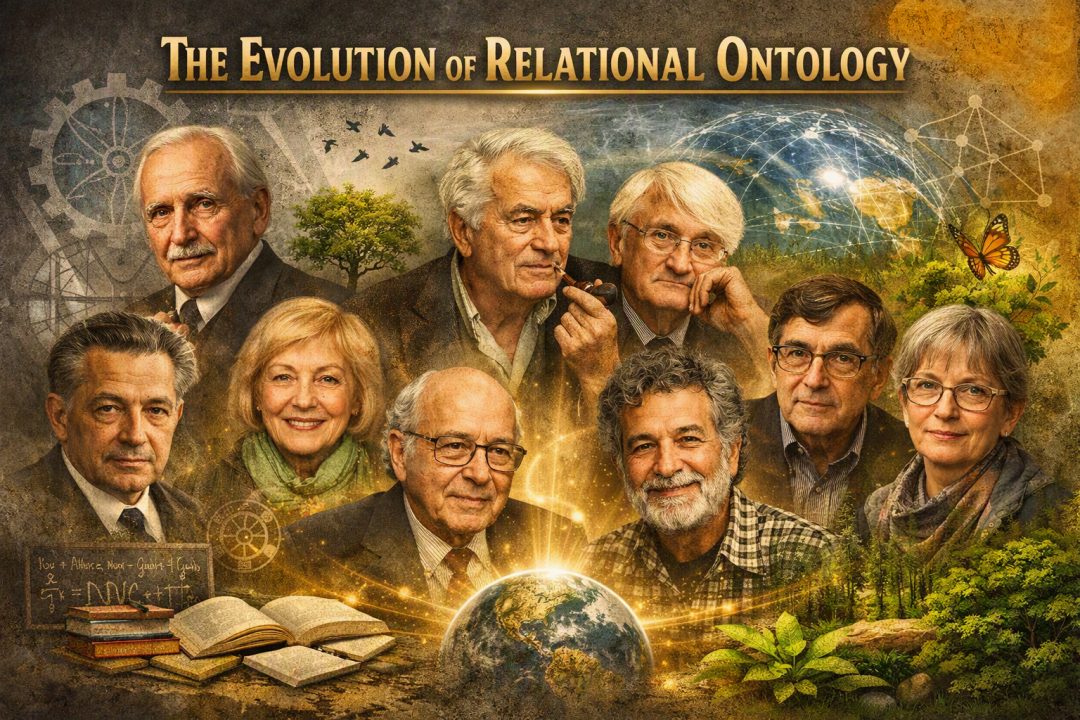
For more than a century, thinkers across philosophy, biology, ecology, anthropology, and systems science have been quietly reshaping how we understand reality. Their work forms a clear evolutionary arc that moves from mechanistic isolation toward relational interdependence.
1. Early Structural Thinkers: Relations as Patterns
Whitehead and early structuralists began challenging the idea that entities exist independently. They argued that relations are not secondary — they are fundamental. This was the first crack in the mechanistic worldview.
2. Systems Science: Relations as Dynamics
Bertalanffy, Bateson, and Prigogine expanded this shift by showing that systems behave through feedback, emergence, and self‑organisation. Here, relations become active forces shaping behaviour, not just static links.
3. Ecological and Biological Thought: Relations as Life Processes
Maturana and Henderson demonstrated that living systems survive through cooperation, adaptation, and mutualism. Relations are now understood as conditions for life itself — not optional, but essential.
4. Relational Agency and Social Theory: Relations as Meaning and Action
Habermas, Latour, Haraway, and Barad showed that agency, identity, and meaning arise through relational networks. Nothing acts alone. Every action is co‑produced through interaction.
5. Symbiosis: Relations as Value Creation
Symbiosis is the culmination of this lineage. It recognises that the most resilient, adaptive, and sustainable systems, biological and organisational, create value through mutual benefit, not one-sided extractions.
Why This Evolution Matters for Symbiotic Business
Symbiotic Business (SB) is not a management trend. It is the applied expression of this entire relational evolution.
SB takes the philosophical insight that reality is relational and turns it into organisational design:
Value emerges from relationships, not isolated units.
Capability grows through interaction, not control.
Resilience comes from diversity and mutualism, not efficiency alone.
Sustainability is achieved through alignment with living‑system dynamics.
SB is what happens when relational ontology becomes organisational practice.
It is the point where philosophy meets business reality.
Understanding this evolution helps us see why mechanistic models are failing and why symbiosis is the next necessary step in building organisations that can thrive in a complex, interconnected world.
