

In an era when many people are questioning the role of finance in society, Triodos Bank has developed a different approach to banking. Rather than focusing solely on financial returns, the organisation seeks to direct money towards projects and businesses that generate positive social, environmental and cultural impact.
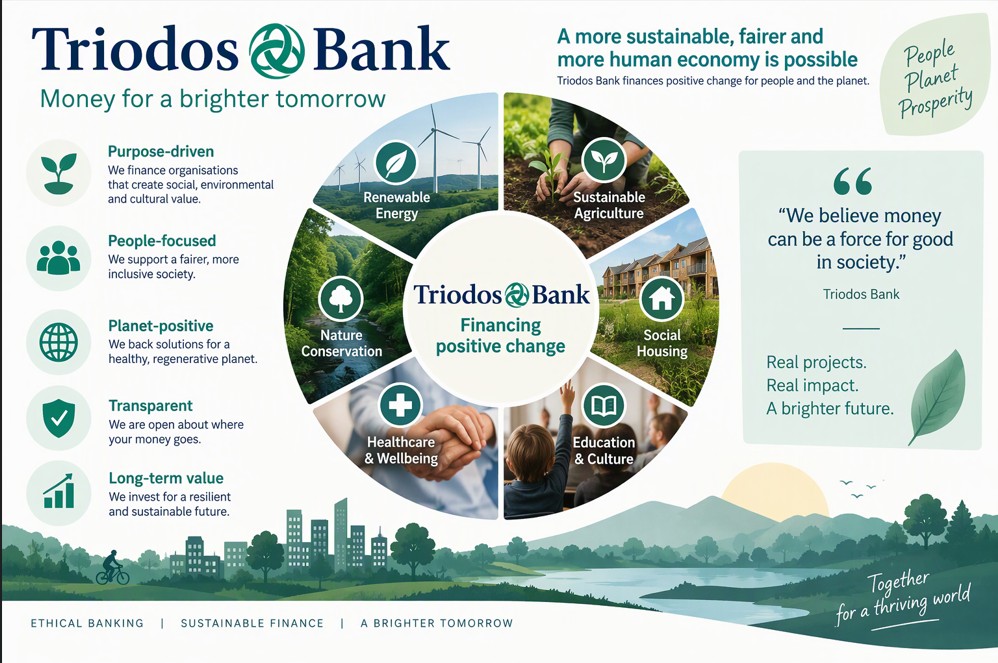
Founded on the belief that finance should serve people and the planet as well as profit, Triodos has become one of Europe’s most recognised ethical banks. Its investments support a diverse range of sectors, including renewable energy, sustainable agriculture, education, healthcare, social housing and cultural initiatives. The bank is also known for its commitment to transparency, openly sharing information about the organisations and projects it finances.
As businesses, investors and consumers increasingly look for ways to align financial activity with sustainability goals, Triodos offers an important example of how banking can contribute to long-term societal wellbeing and ecological resilience. Its model demonstrates that financial success and positive impact do not have to be mutually exclusive.
This article explores Triodos Bank through the lens of sustainable and responsible business, examining how its practices contribute to social value, environmental stewardship and a more resilient economic system.
Triodos Bank:
A Symbiotic Business Assessment™
Overview
Triodos Bank is widely recognised as one of the world’s leading ethical and sustainable banks. Founded with the purpose of using finance to create positive social, environmental and cultural impact, the bank seeks to align financial activity with broader societal wellbeing. Unlike conventional banking institutions that primarily optimise for financial returns, Triodos explicitly considers the social and ecological consequences of investment decisions.
From a Symbiotic Business Assessment™ perspective, Triodos provides a compelling case study of how financial institutions can contribute to mutual benefit between people, communities, economies and ecosystems.
Ecological Capital
Triodos demonstrates a strong commitment to ecological value creation through its support for renewable energy, sustainable agriculture, organic food production, nature restoration initiatives and environmentally responsible enterprises.
The bank actively directs capital towards activities that support the transition to a low-carbon and more sustainable economy. Its financing decisions suggest a clear recognition that healthy economic systems depend upon healthy ecological systems.
Indicative Assessment: Strong
Human Capital
Triodos places significant emphasis on human wellbeing, both within its workforce and through the organisations it finances. The bank supports projects that contribute to healthcare, education, social housing and community development.
Its mission-driven approach also appears to foster strong employee engagement through meaningful work and a clearly defined organisational purpose.
Indicative Assessment: Strong
Social Capital
Social value creation is central to the Triodos model. The organisation finances projects that strengthen communities, improve access to essential services and support social inclusion.
Transparency regarding lending activities further strengthens public trust and accountability, helping build relationships with customers and stakeholders.
Indicative Assessment: Very Strong
Knowledge Capital
Triodos plays an important educational role by promoting awareness of sustainable finance and responsible investment. Through publications, impact reporting and public engagement, the bank contributes to broader understanding of how finance can influence society and the environment.
Its long-standing experience in ethical banking also represents a significant repository of organisational learning and expertise.
Indicative Assessment: Strong
Economic Capital
As a regulated financial institution, Triodos must maintain financial viability while achieving its social and environmental objectives. The bank’s longevity and international presence suggest that it has developed a viable economic model capable of supporting mission-driven banking activities.
Its approach demonstrates that financial performance and positive impact can operate together rather than as opposing goals.
Indicative Assessment: Strong
Governance Capital
Governance is one of Triodos Bank’s distinguishing strengths. The organisation is recognised for transparency in lending and investment activities and for maintaining a clearly articulated mission and values framework.
The integration of purpose into governance structures strengthens alignment between decision-making, accountability and long-term impact.
Indicative Assessment: Very Strong
Relational Capital
Triodos has developed long-term relationships with customers, investors, social enterprises, charities, environmental organisations and community groups.
These stakeholder relationships form an important part of the bank’s operating model and enhance its ability to generate mutual benefit across multiple sectors.
Indicative Assessment: Strong
Symbiotic Value and Balance
The defining strength of Triodos Bank lies in its ability to create value across multiple capitals simultaneously. Rather than maximising financial returns in isolation, the bank seeks to generate economic, social and ecological benefits together. This integrated approach closely aligns with the principles of symbiotic business, where organisational success is linked with the wellbeing of wider systems.
The organisation appears to exhibit a relatively high degree of balance across capitals, with no obvious indication of one area being systematically prioritised at the expense of others.
Provisional SBA Conclusion
Based on publicly available information, Triodos Bank appears to be a strong example of a symbiotic organisation operating within the financial sector. Its commitment to transparency, sustainable investment, stakeholder value creation and long-term societal impact aligns closely with the principles underlying the Symbiotic Business Assessment™.
While a full SBA assessment would require detailed evidence review and scoring, Triodos Bank would likely be considered a leading benchmark organisation for organisations seeking to demonstrate that finance can serve people, communities, economies and ecosystems simultaneously.
