
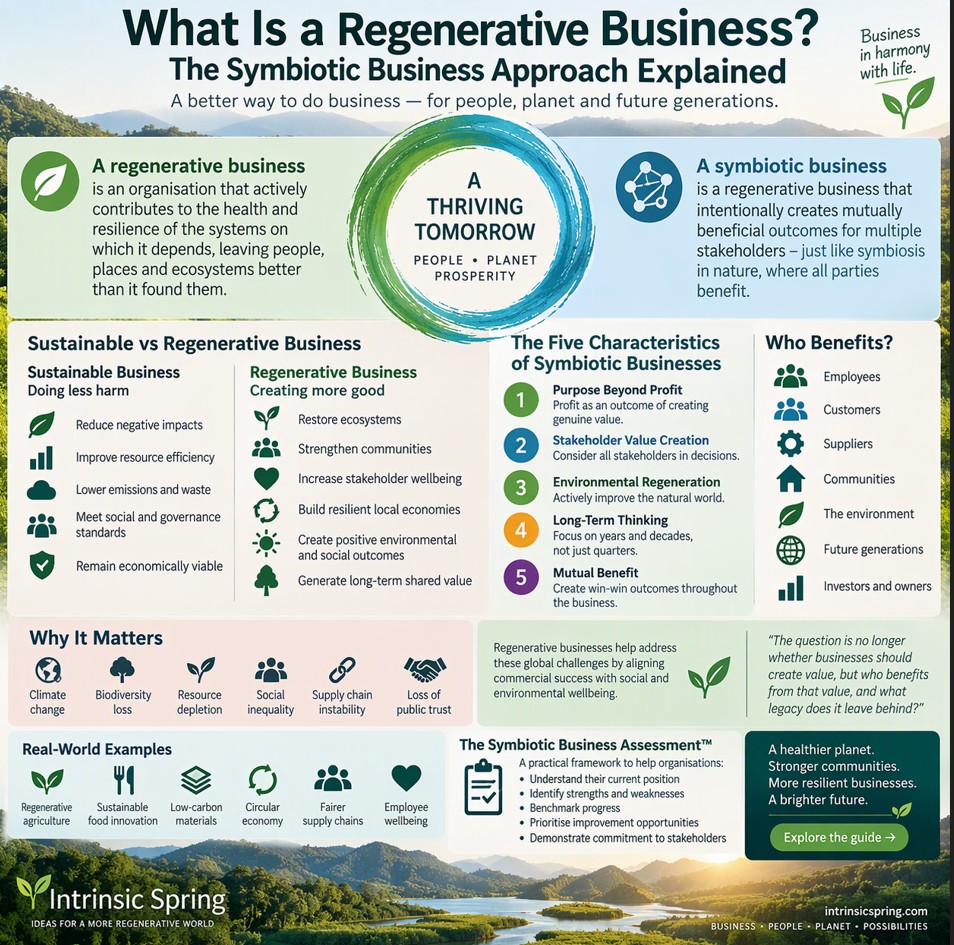
What Is a Regenerative Business? The Symbiotic Business Approach Explained
Many businesses aim to reduce their negative impact on the environment and society. Regenerative businesses go a step further. Rather than simply doing less harm, they seek to create positive outcomes for people, communities, ecosystems and future generations.
This article explains what a regenerative business is, how it differs from traditional sustainability approaches, and how the Symbiotic Business Assessment™ can help organisations understand and improve their impact.
What Is a Regenerative Business?
A regenerative business is an organisation that actively contributes to the health and resilience of the systems on which it depends.
These systems include:
- People and employees
- Customers and communities
- Supply chains
- Natural ecosystems
- Local and global economies
- Future generations
Instead of focusing solely on profit maximisation, regenerative businesses aim to create mutually beneficial relationships across all stakeholders.
In simple terms, a regenerative business leaves people, places and ecosystems better than it found them.
Regenerative Business vs Sustainable Business
The terms sustainable business and regenerative business are often used interchangeably, but there is an important distinction.
Sustainable Business
A sustainable business seeks to:
- Reduce negative environmental impacts
- Improve resource efficiency
- Lower emissions and waste
- Meet social and governance standards
- Remain economically viable
Regenerative Business
A regenerative business seeks to:
- Restore ecosystems
- Strengthen communities
- Increase stakeholder wellbeing
- Build resilient local economies
- Create positive social and environmental outcomes
- Generate long-term shared value
Sustainability often asks:
“How can we do less harm?”
Regeneration asks:
“How can we create more good?”
What Is a Symbiotic Business?
A Symbiotic Business is a regenerative business that intentionally creates mutually beneficial outcomes for multiple stakeholders.
Just as symbiotic relationships in nature benefit the organisms involved, symbiotic businesses create value that is shared rather than extracted.
A symbiotic business considers:
- Employees
- Customers
- Suppliers
- Communities
- The environment
- Future generations
- Investors and owners
Success is measured not only by financial performance but also by the quality of these relationships and the outcomes they generate.
The Five Characteristics of Symbiotic Businesses
- Purpose Beyond Profit
Profit remains important, but it is viewed as an outcome of creating genuine value rather than the sole objective.
- Stakeholder Value Creation
Decisions are evaluated according to how they affect all stakeholders rather than a single group.
- Environmental Regeneration
The business actively contributes to environmental improvement through its products, services or operations.
- Long-Term Thinking
Strategic decisions consider impacts over years and decades rather than quarterly reporting periods.
- Mutual Benefit
The organisation aims to create win-win outcomes wherever possible throughout its activities and relationships.
Real-World Examples
Many companies demonstrate aspects of regenerative and symbiotic business thinking.
Examples often cited include organisations that:
- Invest in regenerative agriculture
- Develop low-carbon materials
- Support circular economy practices
- Share value more fairly across supply chains
- Prioritise employee wellbeing and development
- Design products for repair, reuse and longevity
While no organisation is perfect, many are demonstrating how business can become a force for positive change.
Why Regenerative Business Matters
The world faces significant environmental, social and economic challenges.
These include:
- Climate change
- Biodiversity loss
- Resource depletion
- Social inequality
- Supply chain instability
- Loss of public trust
Traditional business models frequently contribute to these challenges.
Regenerative and symbiotic business models seek to address them by aligning commercial success with social and environmental wellbeing.
As consumers, employees, investors and regulators increasingly expect responsible behaviour, regenerative business practices are becoming a strategic advantage rather than a niche concern.
Introducing the Symbiotic Business Assessment™
The Symbiotic Business Assessment™ (SBA) is a practical framework designed to evaluate how effectively an organisation creates mutually beneficial outcomes.
The assessment helps organisations:
- Understand their current position
- Identify strengths and weaknesses
- Benchmark progress
- Prioritise improvement opportunities
- Demonstrate commitment to stakeholders
Rather than relying on marketing claims alone, the SBA encourages structured evaluation across multiple dimensions of business performance and impact.
Questions Every Organisation Should Ask
- Who benefits from our success?
- Who may be disadvantaged by our activities?
- Are we creating value or merely extracting it?
- Do our suppliers prosper alongside us?
- Are we improving or degrading natural systems?
- Would future generations thank us for our decisions?
- Are our relationships genuinely mutually beneficial?
The answers to these questions reveal how closely an organisation aligns with regenerative and symbiotic principles.
The Future of Business
The future is unlikely to belong solely to businesses that produce the cheapest products or the highest short-term returns.
Increasingly, success will depend on the ability to build trust, resilience, innovation and long-term value.
Regenerative businesses recognise that healthy organisations depend upon healthy communities, healthy economies and a healthy planet.
Symbiotic businesses take this principle one step further by intentionally creating value that is shared across all stakeholders.
The organisations that master this approach may become the most resilient, trusted and successful businesses of the coming decades.
Conclusion
Regenerative business represents a shift from minimising harm to creating positive impact.
The Symbiotic Business approach builds on these ideas by focusing on mutually beneficial relationships between businesses, people, communities and the natural world.
As sustainability evolves beyond compliance and risk management, organisations have an opportunity to become genuinely regenerative, resilient and symbiotic.
The question is no longer whether businesses should create value.
The question is: who benefits from that value, and what legacy does it leave behind?
