

Rêve En Vert has become one of the clearest examples of how fashion can evolve beyond sustainability and into genuine symbiosis. Their ethos places ecological regeneration, social fairness, and long‑term economic responsibility at the centre of every decision. By curating designers who work with nature rather than against it, and by championing slow, transparent production, Rêve En Vert shows what a modern, regenerative business model can look like. This post explores why their approach aligns so strongly with the principles of Symbiotic Business and what it means for the future of conscious fashion.
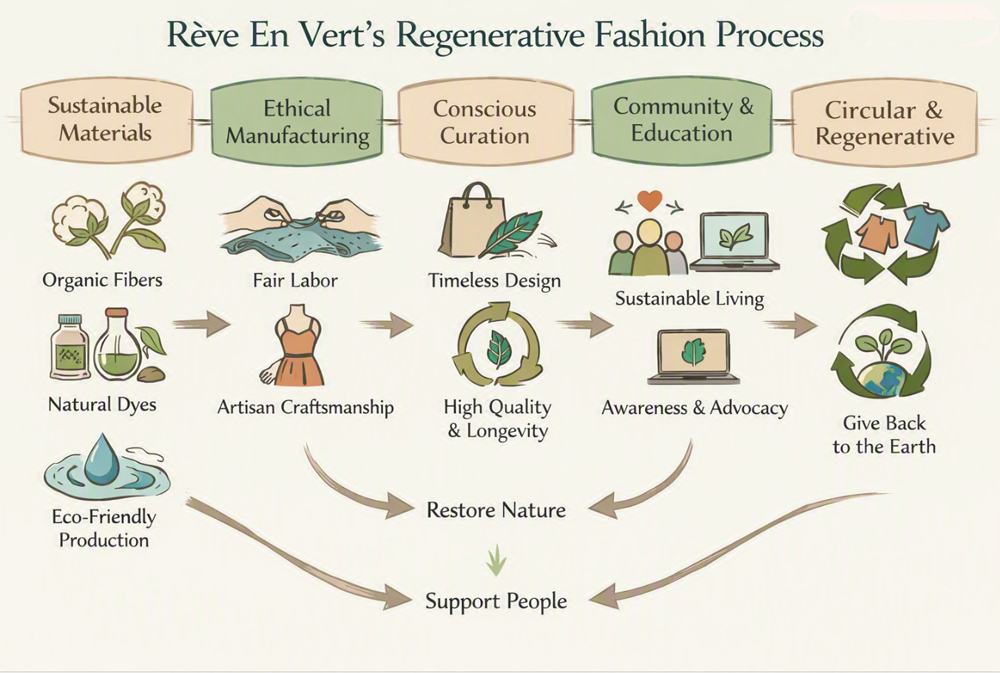
Rêve En Vert operates as a regenerative fashion platform whose core processes align closely with the principles of Symbiotic Business—a model in which commercial activity enhances, rather than extracts from, ecological and social systems.
Intrinsic Value Alignment
Rêve En Vert’s product curation is built on intrinsic sustainability criteria rather than market‑driven aesthetics. Brands are selected based on measurable ecological performance:
low‑impact fibres
regenerative agriculture inputs
ethical labour standards
circular design methodologies
This ensures that the platform’s commercial offering is structurally aligned with long‑term ecological value creation—an essential characteristic of Symbiotic Business.
Transparent, Traceable Production Systems
The company emphasises full supply‑chain transparency, enabling customers to understand the environmental and social impacts embedded in each product. This transparency functions as a symbiotic feedback loop, allowing:
consumers to make informed, values‑aligned decisions
producers to improve processes based on real‑time ethical and ecological expectations
Such feedback loops are foundational to Symbiotic Business because they create continuous, mutual improvement between stakeholders.
Circularity as Operational Logic
Rêve En Vert promotes circular design principles across its brand ecosystem:
durability
repairability
recyclability
biodegradable materials
Circularity is not treated as an add‑on but as a systemic operational constraint, mirroring Symbiotic Business’s requirement that economic activity must operate within ecological boundaries rather than outside them.
Regenerative Impact Model
The platform’s ethos extends beyond “sustainable consumption” toward regenerative fashion, where the aim is to restore ecological systems rather than merely reduce harm. This includes:
supporting regenerative farming
prioritising carbon‑positive materials
encouraging long‑term wardrobe stewardship
This regenerative orientation is a direct expression of Symbiotic Business’s principle of net‑positive system contribution.
Community‑Centric Value Distribution
Rêve En Vert’s model distributes value across a wider ecosystem:
small ethical designers
regenerative farmers
conscious consumers
environmental NGOs
This multi‑stakeholder value distribution is a hallmark of Symbiotic Business, which rejects linear value extraction in favour of mutual benefit across interconnected actors.
Educational Function as a System Lever
Through editorial content, guides, and transparent product narratives, Rêve En Vert acts as an educational infrastructure, shifting consumer behaviour toward ecological literacy. Education is a key lever in Symbiotic Business because it transforms the demand‑side of the market, enabling systemic change rather than isolated product substitution.
Technical Summary
Rêve En Vert is a Symbiotic Business because it integrates ecological constraints, regenerative production, transparent value chains, circular design, and multi‑stakeholder benefit into a single operating system. Its commercial activity strengthens the ecological and social systems it depends on, fulfilling the core requirement of symbiotic value creation.
